Deliverance Ministry
(Exorcism)

ICM authorises the use of exorcism for those who are believed to be the victims of demonic possession.
In Catholicism, exorcism is sacramental, but not a sacrament, unlike baptism or confession. Unlike a sacrament, exorcism's "integrity and efficacy do not depend ... on the rigid use of an unchanging formula or on the ordered sequence of prescribed actions. Its efficacy depends on two elements: authorisation from valid and licit Church authorities, and the faith of the exorcist."
The Catechism of the ICM states: "When the Church asks publicly and authoritatively in the name of Jesus Christ that a person or object be protected against the power of the Evil One and withdrawn from his dominion, it is called exorcism.
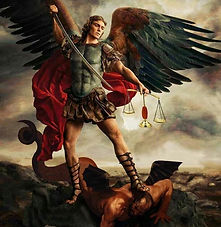
Solemn exorcisms, according to the law of the Church, can be exercised only by an ordained priest (or higher prelate), with the permission of his/her Superior, and only after a full investigation and careful medical examination to exclude the possibility of mental illness.
Things listed in the Rite of Exorcism as being indicators of possible demonic possession include:
Speaking foreign or ancient languages of which the possessed has no prior knowledge;
Supernatural abilities and strength;
Knowledge of hidden or remote things which the possessed has no way of knowing;
An aversion to anything holy; and profuse blasphemy and/or sacrilege.
The first official guidelines for exorcism were established in 1614, whereas grimoires were widely known and used since the Ancient period. .
In the 15th century, Catholic exorcists were both priestly and lay, since every Christian was considered as having the power to command demons and drive them out in the name of Christ. These exorcists used the Order of Saint Benedict's formula "Vade retro satana" ("Step back, Satan") around this time (this prayer is inscribed on the Saint Benedict Medal sacramental).

By the late 1960s, Catholic exorcisms were seldom performed, but by the mid-1970s, popular film and literature revived interest in the ritual, with thousands claiming demonic possession. Maverick priests who belonged to fringes took advantage of the increase in demand and performed exorcisms with little or no official sanction.
The exorcisms that they performed were, according to the Contemporary Religion, “clandestine, underground affairs, undertaken without the approval of the Catholic Church and without the rigorous psychological screening that the church required."
In subsequent years, the Church took more aggressive action on the demon-expulsion front. The practice of exorcism without consent from the Catholic Church is what prompted the official guidelines from 1614 to be amended.
The amendment established the procedure that clergy members and each individual who claims to be impacted by demonic possession must follow.
This includes the rule that the potentially possessed individual must be evaluated by full paranormal investigation and if possible a medical professional before any other acts are taken.
The primary reason for this action is to eliminate any suspicion of mental illness, before the next steps of the procedure are taken.
Exorcism of St Benedict
By the twentieth-century Catholic officials regarded genuine demonic possession as an extremely rare phenomenon that is easily confused with mental illness. Demand for exorcisms increased in the early twenty-first century and the number of trained exorcists increased. Prior to the late twentieth century, exorcists were mainly anonymous, and the performance of exorcisms remained a secret. Some exorcists [who?] attributed the rise in demand of exorcisms to a rise in drug abuse and violence, leading to the suggestion that the two were related. The Church point of view is that some people need only spiritual or medical help, especially if drugs or other addictions are present, and not exorcism.
The Church view is that trained priest and medical professionals can work together to help a patient, and to be able to determine if the patient is suffering from an illness or not.
Spiritual needs are dealt with by prayers, the laying on of hands or a counselling session. Particular sacramentals, such as the wearing of a cross necklace or usage of blessed salt, are believed by the Church to offer protection against Satan when used with faith. Certain theologians have held that the wearing of a head covering by Christian females confers protection against fallen angels, which they teach are referenced in 1 Corinthians 11:3–10. Characteristics
What the Church views as signs of demonic invasion vary depending on the type of demon and its purpose, including:
Using languages unknown to the person or people around them.
Having extraordinary strength or resistance to physical restraint.
Knowledge of events or people that the person could not have possibly known.
An aversion to holy objects or places, such as holy water or churches.
Self-harming and displaying violent or aggressive behaviour.
Ailments or conditions that cannot be diagnosed or treated medically.
Having hallucinations or hearing voices.
An abrupt change in behaviour or personality.
Sudden spiritual dryness.
Expelling of objects or animals through the mouth.
Process of the exorcism
In the process of an exorcism the person possessed may be restrained so that they do not harm themselves or any person present. The exorcist then prays and commands for the demons to retreat. The Catholic priest recites certain prayers – the Lord's Prayer, Hail Mary, and the Nicene Creed. Exorcists use a cross and holy water and follow procedures listed in the Ritual of the exorcism.

Seasoned exorcists use the Rituale Romanum as a starting point, not always following the prescribed formula exactly.
After the exorcism has been finished the person possessed feels a "kind of release of guilt and feels reborn and freed of sin."
Not all exorcisms are successful the first time; it could take days, weeks, or even months and years of constant prayer.
If you feel you or a family member are being spiritually attacked in your home and need assistance. Please fill out form.
We will respond ASAP